




















Weaving
“The new weaving facility represents a turning point for our company and completes a strategic part of our production process that we have long aimed to achieve.”
Made in Italy Style
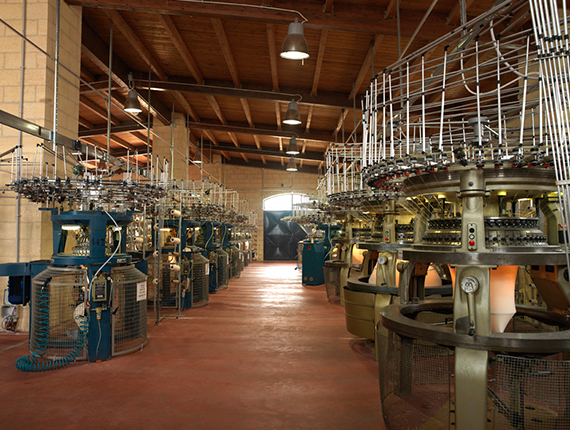
A production facility covering over 1,700 square metres, housed in an impressive recently renovated building, accommodates the production equipment of Textile Industry, the Brio Group company specialising in weaving. 27 circular knitting machines
are used to produce 100% cotton fabrics, including interlock, rib, jersey, dual (wool-cotton) and tubular cotton. BRIO Lingerie® is one of the very few manufacturers of tubular cotton in Italy. Fabrics can be produced in yarn counts 24:1, 30:1, 36:1, 40:1, 60:1, 60:2 and 80:2.
To complete the production cycle and garment manufacturing supply chain, four machines for the production of elastic bands have recently been installed, enabling the company to meet all its internal requirements.
The traditional weaving process is divided into preparation and production stages. The preparatory stage includes preparing the weft yarn packages installed on the loom and preparing the warp through the warping process, using a creel and warping machine. The weaving process itself consists of several stages, including warping, sizing and the main weaving process.
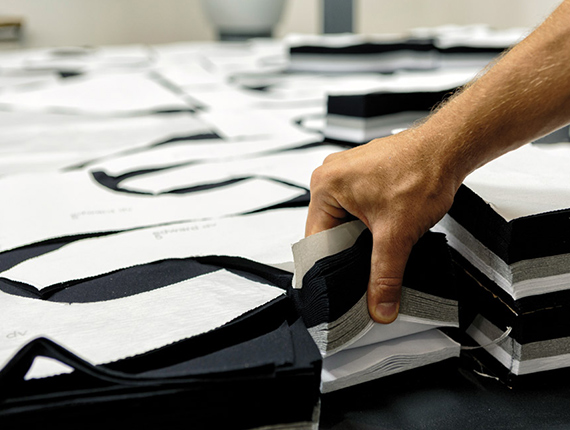
“The manufacturing of our products is the stage we care about most. This is how our designs take shape and how our commitment to quality comes full circle.”
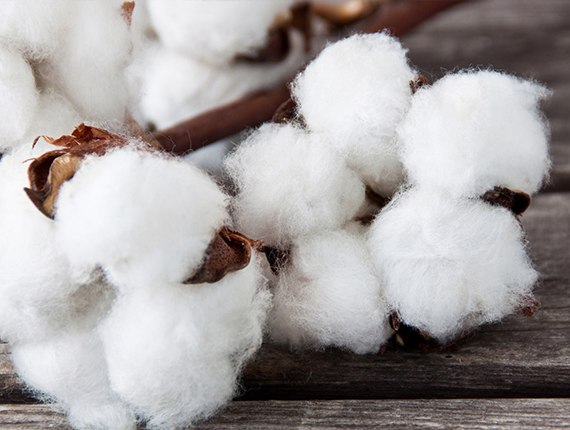
Cotton (Gossypium, Linnaeus 1758) is a shrub belonging to the Malvaceae family, native to the Indian subcontinent and the tropical
and subtropical regions of Africa and the Americas, and was introduced into Europe by the Arabs. In the wild, the plant can grow to more than 1.5 metres in height and has a long lifespan. It is cultivated in many countries for the production of cotton fibre, which is obtained from the soft fibres surrounding the seeds and used to manufacture fabrics.
Together with wool, cotton is one of the most important raw materials in the textile industry. Ancient Egyptian hieroglyphic records provide evidence of knowledge of cotton fabric-making techniques, while Herodotus also wrote about the use of cotton fibre in the 5th century BC. Cotton became widespread throughout the Mediterranean region and was also well known to the Aztecs in the Americas, although it was not until the 18th century that cotton fabrics experienced renewed widespread popularity on the continent.
Over the last two centuries, cotton production has experienced several major crises, including those that occurred during the American Civil War in the Southern States and during the Great Depression of 1929. According to 2005 data from the United States Department of Agriculture, the world's largest cotton producers were: China (5.7 million tonnes), the United States (5.2), Pakistan (2.1), Uzbekistan (1.2) and Brazil (1). All other countries individually produced less than one million tonnes. (Source: Wikipedia)
Types of Yarn
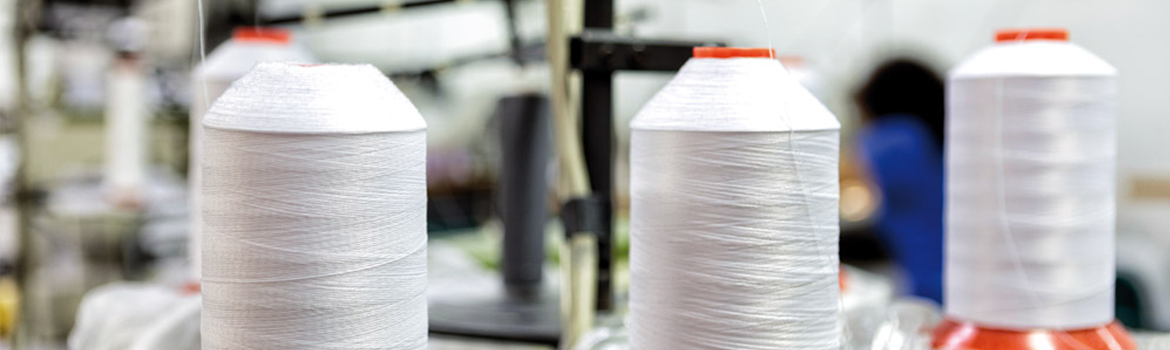
“Cotton yarn is obtained by spinning fibres taken from the soft material surrounding the seeds. Below is an overview of the different types of yarn and their main characteristics.”
Virgin
Obtained from fibres processed for the first time.Regenerated
Obtained by reprocessing previously used fabrics.Mercerised
Treated in a concentrated caustic soda solution at 30° Bé (Baumé). Mercerisation is carried out at a low temperature (10°C). The soda treatment changes the cross-section of the yarn, producing finished garments with a better feel, greater lustre, improved hygroscopic properties and enhanced dye affinity.Gassed
Produced by passing the yarn over a small flame at a controlled speed. The protruding fibres are burned away, leaving the cotton yarn more uniform and smoother, with a clean, dry feel. As combustible gas is used to produce the flame, this treatment is known as “gassing”.Combed
Produced using cotton fibres of a selected length. The result is a high-quality, strong cotton yarn with a smooth, lustrous appearance and minimal hairiness. During combing, short fibres, impurities and neps are removed, producing a sliver of parallel fibres with a uniform length. During drawing, the cotton slivers are combined and evened out to achieve a uniform yarn count throughout their length.Makò
The common name for high-quality Upper Egyptian cotton, with fibres measuring between 30 and 34 mm in length. It is used in the production of premium-quality cotton fabrics.Filo di Scozia
Produced from first-grade Egyptian cotton, or cotton with equivalent characteristics. It is made from some of the world's finest long-staple cotton yarn and undergoes five rigorous processing stages:
- combing
- twisting
- gassing
- yarn mercerisation
- dyeing
with a yarn count of no less than Ne 50/2.